

MDMA: What It Is, Its Effects, Risks, Adulterants, and Why Testing Matters

💊 Everything Worth Knowing About MDMA: Effects, Differences from Ecstasy, Potential Risks, and the Importance of Testing 🔬
MDMA is one of the most well-known psychoactive substances associated with club culture, festivals, and profound emotional experiences. For many people, it symbolizes euphoria, closeness, and intense connection with music and others. While some users perceive it as "pure ecstasy," the reality of today's market is often far more complex. ⚠️
On the illegal market, the composition of substances can vary drastically from pill to pill. Adulterants, substitutes, or mixtures of multiple substances are not uncommon, and this is where the greatest risks arise. The less information someone has about what they're actually holding, the higher the likelihood of unexpected and sometimes dangerous reactions. 🔬 Testing doesn't mean supporting use—it means trying to reduce unnecessary risks.
This article clearly explains what MDMA is, how it affects the body and psyche, what the difference is between MDMA and ecstasy, what the main risks are, why there's discussion about its therapeutic use, and most importantly why testing MDMA makes sense.
🧠 What is MDMA
MDMA (3,4-methylenedioxymethamphetamine) is a synthetic psychoactive substance that combines stimulant effects with what's called an empathogenic effect—intensified experiences of emotions, empathy, and social closeness. This combination sets it apart from typical stimulants like amphetamines or cocaine.
At the neurochemical level, MDMA significantly affects:
- serotonin – responsible for mood, feelings of happiness, and emotional connection
- dopamine – related to motivation, reward, and energy
- norepinephrine – influencing alertness and physical activation
The result is a state that many people describe as intense, open, and emotionally charged, yet also physically stimulating.
✨ Typical Effects of MDMA
Effects can vary depending on dose, environment, mental state, and substance purity, but the most common include:
💬 increased feelings of empathy and closeness
People tend to open up more easily, communicate better, and experience a stronger sense of connection with others.
⚡ more energy and alertness
MDMA stimulates the body, suppresses fatigue, and increases the desire to move or dance.
🎶 intensified perception of music and sensory stimuli
Music, lights, or touch can feel significantly stronger than usual.
❤️ emotional openness and lowered inhibitions
Fear, shame, and social barriers are weakened, which can be perceived as very pleasant but also increases vulnerability.
This combination of psychological and physical effects is what drives MDMA's popularity in the party scene, at festivals, and in environments centered around music, dance, and social interaction. 🎧🕺
📜 A Brief History of MDMA
MDMA was first synthesized as early as 1912 by the pharmaceutical company Merck. It wasn't originally intended for recreational use—it was created as an intermediate product during the development of other compounds and went largely unnoticed for decades. 🔬
Interest in MDMA reemerged in the 1970s, when some psychotherapists and psychiatrists began to take notice. In controlled settings, they used it as a supportive tool in therapy, noting its ability to reduce fear, increase openness, and facilitate emotional work.
In a therapeutic context, MDMA was used mainly for:
- 🧩 opening emotions and reducing defensive mechanisms
- 🧠 working with traumatic experiences that patients otherwise struggled to access
- 🤝 improving communication between therapist and client
At this stage, MDMA was viewed more as a tool for deeper self-knowledge, not as a "party drug."
The turning point came in the 1980s, when MDMA began spreading beyond therapeutic circles and gradually became part of the emerging club and rave scene. Popularity surged, as did media and regulatory attention. A blanket ban followed, and MDMA moved exclusively to the illegal market.
And that's where the situation fundamentally changed. ⚠️
While it used to be a relatively consistent substance used in controlled conditions, on today's illegal market:
- there is no uniform quality
- composition varies pill to pill
- adulterants and substitutes are common
What circulates today under the name MDMA or ecstasy often shares only the name with the original substance.
💊 MDMA vs. Ecstasy – What's the Difference?
The difference between MDMA and ecstasy is one of the most common points of confusion and also one of the biggest sources of risk.
- MDMA = a specific chemical compound
- Ecstasy = street term, usually referring to tablets or pills
While MDMA is a precisely defined compound, the term "ecstasy" says nothing about the actual composition. It's used more as a marketing or slang term.
⚠️ A tablet sold as "ecstasy":
- ❌ may not contain any MDMA at all
- 🔀 may contain a mixture of several substances
- ☠️ may be partially or completely counterfeit
In practice, tablets often contain:
- other stimulants
- synthetic cathinones
- or highly dangerous substitutes like PMA/PMMA
The fact that a pill has:
- a certain logo
- a specific color
- or a "good reputation" among people
means nothing at all in terms of safety or composition. A logo or name is not a guarantee of MDMA.
This is precisely why testing is essential. Without testing, you're just guessing—and on the illegal market, guessing is often the riskiest thing you can do. 🔍
✨ What Effects Does MDMA Have and Why Do People Use It
MDMA is sought after primarily for its ability to combine physical stimulation with an intense emotional experience. Unlike purely stimulating substances, it doesn't just work "energetically" but also significantly influences the perception of emotions, relationships, and the surrounding environment.
People most commonly seek it for:
🌈 euphoria and a sense of connection
MDMA increases serotonin levels, leading to feelings of well-being, closeness, and strong emotional connection with others. Many describe a state where they feel "everything makes sense" and relationships are more intense and open.
🕺 energy for dancing and movement
The stimulating component of MDMA suppresses fatigue, increases physical endurance, and boosts the desire to move. This is one reason why MDMA is closely associated with club and festival culture.
🎧 stronger musical and sensory experience
Music, lights, and touch can feel significantly more intense. People often describe deeper immersion in music and stronger emotional responses to sounds and rhythms.
💬 easier communication and openness
MDMA reduces social inhibitions, fear of judgment, and shame. This can lead to more open conversations, sharing of emotions, and a sense of greater authenticity.
🔍 Why Effects Vary So Much
MDMA effects are not universal and can vary significantly from person to person and situation to situation. They are influenced especially by:
- 🧪 substance purity – the more adulterants, the less predictable the effects
- 🔀 presence of other substances – substitutions or mixtures can completely change the course of effects
- 🧠 mental state and expectations – stress, fatigue, or psychological discomfort play a major role
- 🌍 environment – safe and familiar setting vs. chaos and overstimulation
- 💧 hydration and physical condition – dehydration and exhaustion increase risks
The unpredictability of effects is one reason why it's important to know the composition of the substance and not underestimate testing. 🔬
⚠️ Risks Associated with MDMA
MDMA risks are related not only to the substance itself but primarily to the fact that on the illegal market it's often unclear what the sample actually contains. Unknown composition and adulterants can significantly increase the burden on the body and psyche.
Main risks include:
🌡️ overheating and dehydration
MDMA raises body temperature and reduces perception of fatigue and thirst. Combined with dancing and hot environments, this can lead to dangerous overheating.
🧠 serotonin depletion
After effects wear off, there can be a temporary drop in mood, fatigue, or emotional emptiness. This state is often called a "serotonin crash."
😵 dopamine/serotonin "crash"
Several days after use, feelings of irritability, sadness, or demotivation may appear. Intensity depends on dose, purity, and individual sensitivity.
⚡ neurotoxicity at high or frequent doses
When the serotonergic system is overloaded, the risk of longer-term impacts on psyche and cognitive functions increases.
🌀 psychological discomfort after effects wear off
Anxiety, confusion, or derealization are not uncommon, especially when MDMA is substituted with other substances.
☠️ Substitutions and Adulterants as the Biggest Risk
Particularly dangerous are substitutions of MDMA with other substances, which may have:
- similar onset of effects
- but significantly higher toxicity
- or different duration of action
Adulterants and substitutes are now one of the biggest risks associated with MDMA. Without testing, it's impossible to reliably know what a sample actually contains—and this is where most problems arise. ⚠️
🧪 Most Common Adulterants in MDMA
One of the biggest problems with today's market is that MDMA is very often mixed, diluted, or completely replaced with other substances. These adulterants can drastically change effects, increase burden on the body, and bring entirely different risks than expected.
Most common adulterants include:
☕ caffeine
Often added to cheaply enhance stimulant effects. Can increase heart rate, blood pressure, and cardiovascular strain, especially combined with dancing, heat, and dehydration.
🧨 cathinones (synthetic stimulants)
These substances can cause strong stimulation, anxiety, overstimulation, paranoia, and severe crashes. Their effects tend to be shorter, more chaotic, and less predictable than MDMA.
🌫️ DXM (dextromethorphan)
A substance with dissociative effects that can cause confusion, disorientation, and unpleasant physical and psychological states. Combined with other stimulants, it can be highly unpredictable.
☠️ PMA/PMMA
Among the most dangerous substitutions. These substances have slower onset, which can lead to unintended redosing. They're associated with overheating, serotonin syndrome, and serious health complications.
🔄 MDA
Chemically related to MDMA but with a different effect profile. Often more stimulating and less empathogenic, can be longer-lasting and harder on the psyche.
⚠️ Without testing, it's impossible to reliably know whether a sample contains pure MDMA, its derivative, or a completely different substance. Adulterants are now one of the main sources of risk.
🔗 Does MDMA Have Addictive Potential?
MDMA is generally not considered a substance with high physical addictive potential, like opioids or nicotine. However, this doesn't mean it's completely without risk.
Risks are primarily related to psychology and pattern of use:
- 🧠 psychological attachment can develop to the experience of euphoria, empathy, or "exceptional states"
- 📉 with more frequent use, effects diminish as the serotonergic system becomes depleted
- ⚠️ risk of long-term impacts increases on mood, motivation, and emotional stability
Another risk factor is attempting to "chase" the previous intense experience:
- with higher doses
- more frequent repetition
- combination with other substances
This can lead to faster depletion of the body and increased likelihood of negative impacts. Harm reduction here mainly means being informed and respecting the body's limits.
🧑⚕️ MDMA and Therapeutic Use
In recent years, MDMA has reemerged in professional discussion, this time within modern clinical research. Its potential is being explored primarily as a supportive tool in psychotherapy.
Research focuses mainly on:
- 🧠 PTSD (post-traumatic stress disorder)
- 🧩 work with deep trauma
- 🤝 facilitating the therapeutic process
MDMA here is not viewed as "treatment itself" but as a tool that can:
- reduce fear
- increase sense of safety
- facilitate openness and processing of difficult topics
⚠️ Context is crucial. Therapeutic use always occurs:
- in a clinical and controlled environment
- with precisely determined dosage
- with pure, laboratory-verified substance
- under professional supervision of trained personnel
This is a fundamental difference from illegal use, where dose control, composition, and safety infrastructure are absent. Conflating these two contexts is one of the most common sources of misunderstanding about MDMA.
🔬 Why Testing MDMA Makes Sense
Testing MDMA is one of the most important tools for reducing unnecessary risks associated with unknown substance composition. It's not about supporting use, but about obtaining information where uncertainty otherwise exists.
It's important to say this openly:
❌ Testing doesn't guarantee safety
No test can ensure that a substance is "safe" or won't cause health complications.
✅ But testing helps reduce risks
It provides the possibility to at least partially understand what a sample contains and avoid the most dangerous scenarios.
🔍 Detecting Counterfeits and Adulterants
One of the main benefits of testing is the ability to detect that a substance isn't what it's claimed to be. Counterfeiting is common on the illegal market, and MDMA is no exception.
Testing can help:
- detect presence of other substances
- alert to mixtures of multiple compounds
- identify potentially high-risk substitutes (e.g., PMA/PMMA)
Without testing, people often rely only on:
- appearance
- color
- logo
- or others' experience
But these are factors that have almost no informational value about actual composition.
🧠 Better Understanding of Composition = Fewer Unexpected Reactions
Unexpected reactions often don't occur because people "don't know what they're doing," but because they don't know what exactly the substance contains.
Testing helps:
- reduce risk of MDMA being substituted with another substance
- detect combinations of stimulants that may be harder on the body
- reduce likelihood of serotonergic system overload
- limit risk of acute conditions like overheating or serotonin syndrome
Information about composition doesn't solve everything, but it significantly reduces the degree of uncertainty.
🧩 Testing as Part of Harm Reduction
Testing MDMA is part of an approach known as harm reduction—an effort to:
- minimize harms
- work with reality, not ideals
- emphasize information, not moralizing
🛑 Harm reduction doesn't mean supporting use.
It means acknowledging that people do use substances—and that information and testing can prevent unnecessary tragedies.
🧪 What Types of MDMA Tests Exist
Several types of tests exist on the market that complement each other. Each answers a slightly different question—and their combination makes the most sense. 🔬 No test is "all-in-one," but together they can significantly reduce risks associated with unknown composition.
🔬 MDMA Test Kit (TLC) – PRO Test – % Purity 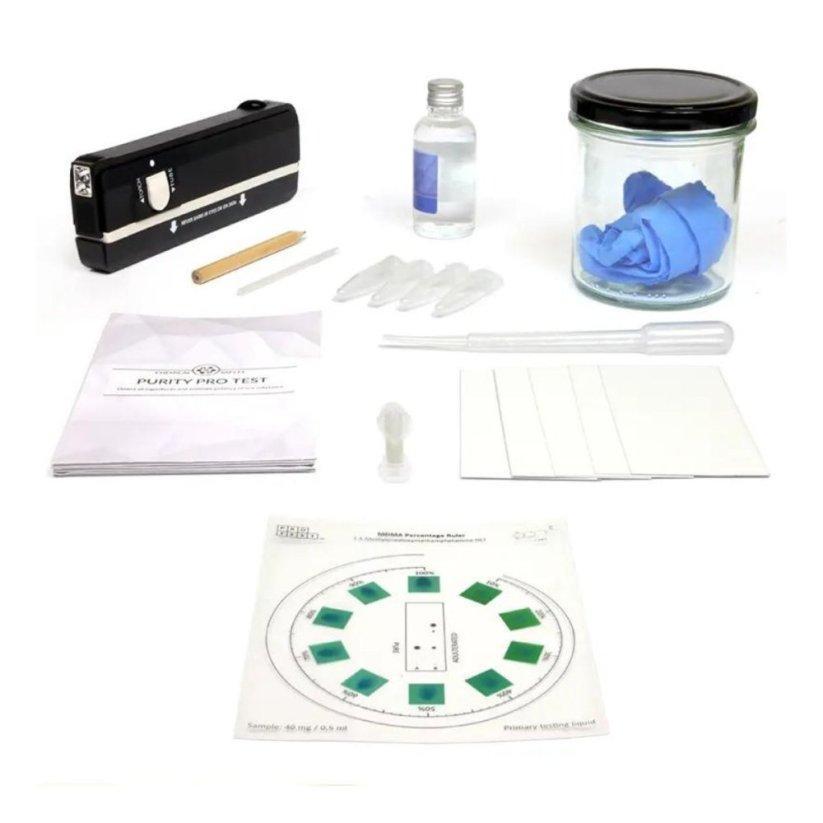
TLC (thin-layer chromatography) is a more advanced method that focuses on composition and relative purity of the sample. It's not a quick color test but an analytical approach that provides deeper insight.
TLC test allows you to:
- 🔍 determine number of components in sample – each substance creates its own trace
- ⚖️ estimate relative amounts of individual substances – larger trace = higher presence
- 🔀 detect mixtures and counterfeits that aren't immediately apparent
This type of test is very useful in situations where:
- sample doesn't seem "standard"
- effects are unpredictable
- there's suspicion of multiple substance mixture
⚠️ Important limitation:
TLC test doesn't determine specific chemical identity of substances. It shows there are multiple components and in what ratio, but doesn't say exactly what they are. 👉 Therefore it's recommended to combine TLC with reagent tests.
🧪 SIMON'S Test – MDMA Detection
SIMON'S test is a quick reagent test that focuses on secondary amines—the chemical group to which MDMA belongs.
How it works: 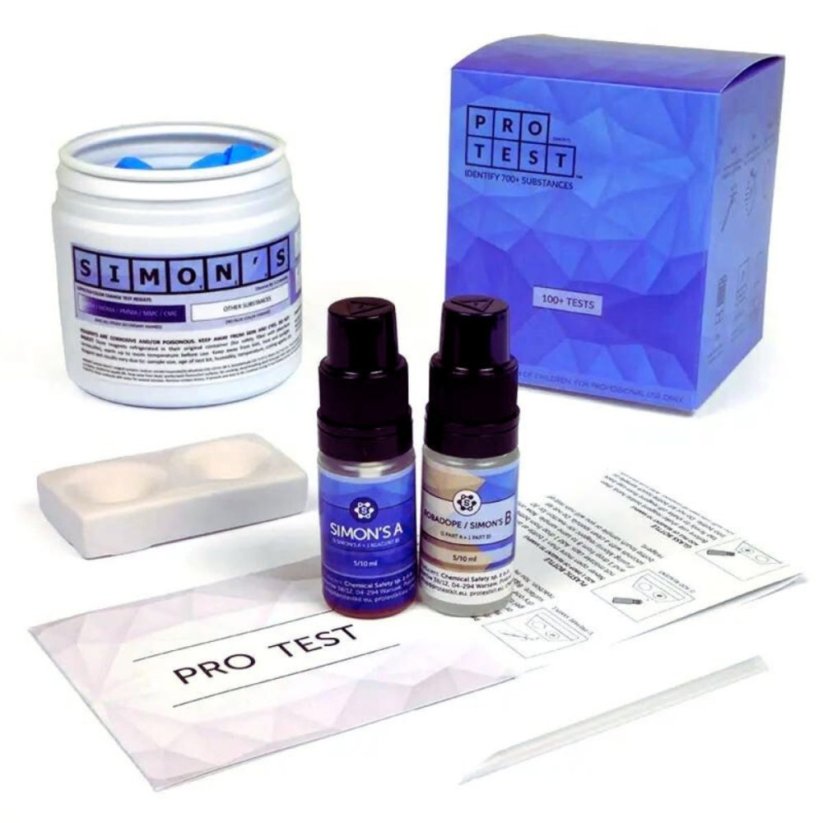
- 🔵 MDMA/MDA → immediate blue reaction
- ❌ other substances → no color change
Its main benefit is that it:
- helps confirm presence of MDMA/MDA
- can distinguish some other stimulants
- provides quick preliminary information
❗ SIMON'S test limitations:
- doesn't determine purity
- doesn't determine quantity
- doesn't detect all possible adulterants
Therefore it's ideal to use it together with TLC test, which supplements composition information.
⚗️ MDMA/Amphetamine/2C-B Test (Marquis)
Marquis reagent is a classic screening test that reacts with color change within seconds. It serves primarily as a first step.
This test: 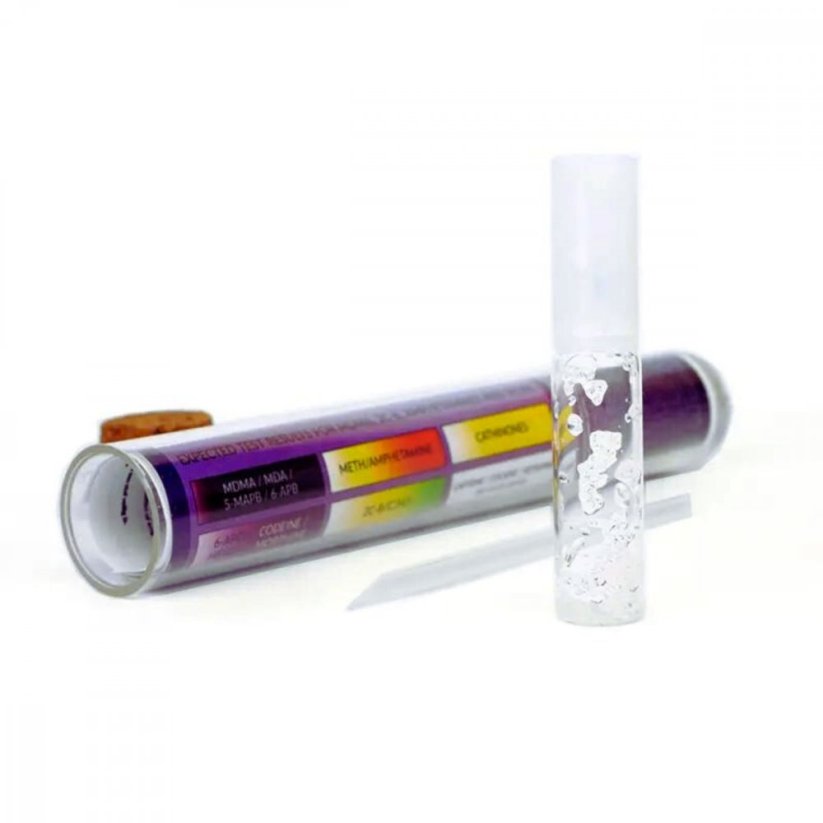
- ⚡ quickly verifies MDMA presence
- 🚫 helps rule out some dangerous substitutes
- 🔍 provides basic information about substance type
It's suitable especially:
- for quick screening
- as initial check
- in combination with other tests
⚠️ Like other reagent tests, it doesn't determine purity or quantity—its strength is in speed, not depth of analysis.
If you're interested in a complete range of drug tests for detecting substance presence and approximate purity, including comprehensive reagent tests, you can check HERE.
✅ Testing Makes Sense
MDMA has a long history, specific effects, and studied therapeutic potential. But the reality of the illegal market is often different—unknown composition, adulterants, and unnecessary risks are a common part of it.
Testing:
- ❌ doesn't guarantee safety
- ✅ but significantly reduces uncertainty
- 🔍 helps detect counterfeits and risky substances
- 🧠 gives better understanding of what sample actually contains